Prints
The press that put gods on every wall
A painter bought a German press, lost it within seven years, and still ended up on almost every wall in India.
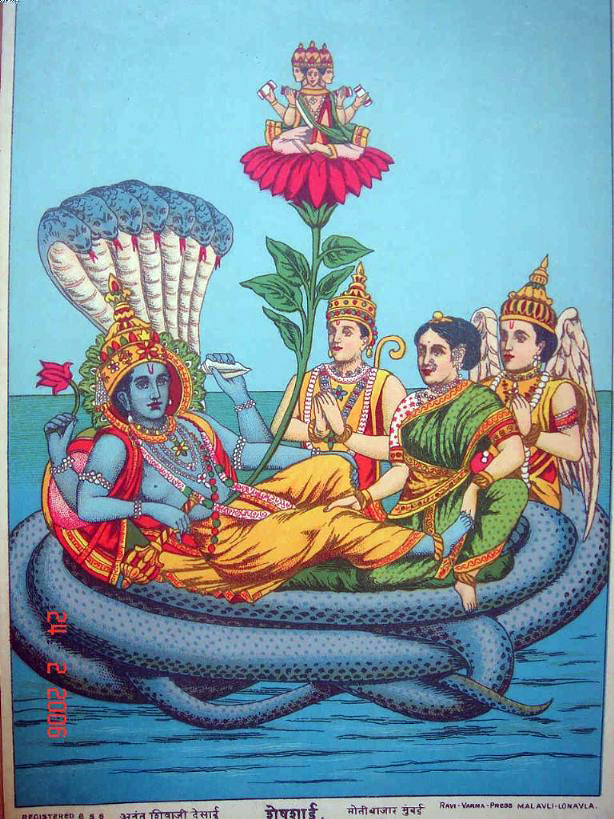
Ask anyone to picture Lakshmi and most will see the same woman: standing on a lotus, a gold-bordered sari, a calm face, water behind her. Nobody alive saw her pose. The picture they carry in their head was printed in Bombay, by a press that opened in 1894.
A painter who wanted more walls
Raja Ravi Varma (1848–1906) painted Hindu gods and the heroines of the epics in the manner of European academic oil painting: soft light, real-looking skin, drapery that falls the way cloth falls. The paintings went to palaces. Very few people ever saw one.
According to MAP Academy’s encyclopedia, T. Madhava Rao, the former Dewan of Travancore, urged Varma as early as 1884 to have his paintings made into prints. In 1892 Varma imported steam-driven press machinery from Germany. Two German litho-transfer artists, Fritz Schleicher and B. Gerhardt, came to install and run it. The machine could pull up to 800 impressions an hour.
Where it started depends on whom you ask
MAP Academy places the first premises in Girgaum, in Bombay, under the name Ravi Varma Fine Art Lithographic Press. Wikipedia places it in Ghatkopar. Both may be right: plague broke out in Bombay in the 1890s, and in 1898 Varma’s partner, Govardhandas Khatau Makhanji, moved the press to Ghatkopar. It later moved again, to Malavli near Lonavala. Wikipedia dates that move to 1899; MAP says the press was working from Malavli by 1901. The press moved house more often than the gods it printed.
Both accounts agree on what came off the stones first: the birth of Shakuntala, then Lakshmi and Saraswati.
What an oleograph is
A chromolithograph is a colour print made from stones, one for each colour, printed one over another. An oleograph is a chromolithograph that has then been made to look like an oil painting, by brushing it with varnish or embossing it, and often by gluing it to canvas. For a household that would never own an oil painting, it was the nearest thing, and it could hang in a kitchen.
The painter lost the press
Varma’s brother, Raja Varma, managed the business. Wikipedia describes it as a commercial failure under the brothers and deep in debt by 1899. In 1901 Varma sold it to Schleicher. MAP gives the terms: a majority interest for 25,000 rupees, with permission to print more than a hundred of Varma’s paintings. Schleicher shortened the name to “F.A.L. Press—Bombay”.
It was the best thing that could have happened to the pictures. Schleicher kept printing Varma’s images, and other artists worked for the press, among them M. V. Dhurandhar, G. V. Venkatesh Rao and Dadasaheb Phalke. In 1906 Phalke set up his own press at Lonavala, which made photo-litho transfers for the Ravi Varma Press. He later left printing to make films.
Schleicher widened the trade to commercial and advertising labels. The gods now shared the presses with product packaging, and kept their place on the walls.
After Varma
Varma died in 1906. The prints did not notice. They kept being printed in thousands for decades, many from designs he never made. A Kali from the press dates from around 1910 to 1920, years after his death. Rival presses copied the Ravi Varma images outright, and after the sale to Schleicher, prints bearing Varma’s signature circulated that had nothing to do with him.
So a print that says “Ravi Varma” in the corner tells you whose name sold it. It does not tell you who drew it, or when.
Schleicher died in 1935 and the press carried on without him. In 1972 a fire destroyed the factory, and many of the original lithographic prints were lost with it. It was revived briefly and closed in 1975. In 2000 the remaining prints and master stones were sold off.
If you have one
Look at the margins first. Many prints carry the press’s name printed below the image, and some give its address at Karla, near Lonavala. Then look at the surface: a true oleograph has varnish and texture laid over a printed image, and under a loupe the colour sits in flat layers, not brushstrokes. Later reprints, and modern digital copies of the old prints, are common. Paper tone, the margin text and the printing method together tell you more than the signature does.
What the press did is easy to miss because it worked so well. A painter’s idea of how a goddess looks became the idea most people hold. It had a printer’s address.
